How to Measure the Real Business Impact of AI Marketing in 2026
AI is transforming marketing faster than any technology before it.
Companies are adopting ChatGPT, AI agents, automated content, AI search optimization, and AI-powered advertising.
But there’s one question boards, CEOs, and founders keep asking:
“How do we know if AI is actually creating business value?”
The answer isn’t more dashboards.
It’s a better measurement framework.
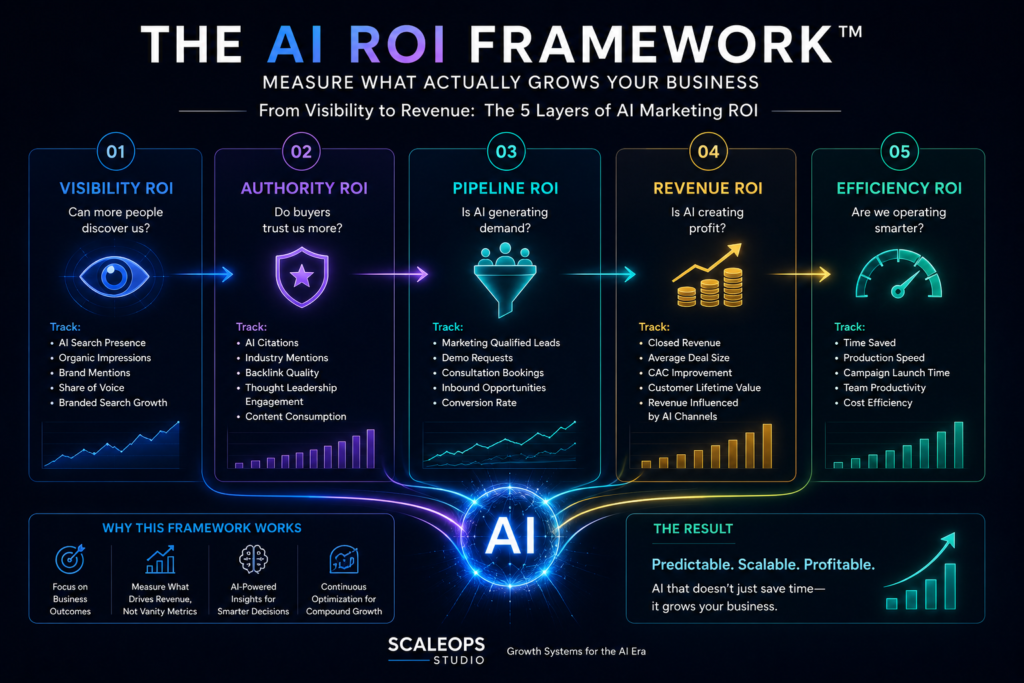
This guide explains how to evaluate AI marketing beyond vanity metrics and introduces the ScaleOps AI ROI Framework™ for measuring visibility, authority, pipeline, and revenue.
Everyone Is Measuring the Wrong Things
Many businesses proudly report:
- Articles generated with AI
- Hours saved
- Campaigns launched
- Images created
- Emails automated
Those metrics sound impressive.
But none of them answer the only question that matters:
Did AI improve the business?
Efficiency isn’t ROI.
Revenue is.
The AI Measurement Problem
Traditional marketing already struggles with attribution.
AI makes it even more complex.
A customer might:
- Discover your brand through ChatGPT
- Read a blog
- Watch a LinkedIn video
- Visit your website two weeks later
- Book a demo after seeing a remarketing campaign
Which touchpoint deserves the credit?
The answer isn’t one channel.
It’s the system.
Why Vanity Metrics Are Dangerous
Businesses often celebrate:
- impressions
- clicks
- followers
- AI-generated content volume
- prompt libraries
These metrics create activity.
But they rarely predict growth.
Instead, companies should ask:
- Are we receiving better-qualified leads?
- Has our sales cycle shortened?
- Are prospects mentioning AI tools during discovery?
- Has branded search increased?
- Are we being referenced in AI-generated answers?
Those are business metrics.
The ScaleOps AI ROI Framework™
At ScaleOps Studio, we measure AI through five business layers.
Layer 1 — Visibility ROI
Measure:
- AI search presence
- Organic impressions
- Brand mentions
- Share of voice
- Branded search growth
Question:
Can more people discover us?
Layer 2 — Authority ROI
Track:
- AI citations
- Industry mentions
- Backlink quality
- Thought leadership engagement
- Content consumption
Question:
Do buyers trust us more?
Layer 3 — Pipeline ROI
Evaluate:
- Marketing Qualified Leads
- Demo requests
- Consultation bookings
- Contact form submissions
- Inbound opportunities
Question:
Is AI generating demand?
Layer 4 — Revenue ROI
Monitor:
- Closed revenue
- Average deal size
- CAC improvements
- Customer lifetime value
- Revenue influenced by AI-driven channels
Question:
Is AI creating profit?
Layer 5 — Efficiency ROI
Finally measure:
- Time saved
- Production speed
- Campaign launch time
- Team productivity
Efficiency matters.
But only after business growth.
The New AI KPIs Every Executive Should Track
Instead of asking:
“How many AI articles did we publish?”
Ask:
- How many AI-driven opportunities entered our pipeline?
- Did AI reduce acquisition costs?
- Did AI improve conversion rates?
- Has our authority increased?
- Are we becoming more visible in AI search?
Those KPIs create better decisions.
Common Mistakes Companies Make
Mistake #1
Measuring outputs instead of outcomes.
Mistake #2
Treating AI as a separate initiative.
Mistake #3
Ignoring authority and trust.
Mistake #4
Optimizing for productivity instead of profitability.
Mistake #5
Expecting immediate ROI from long-term authority investments.
Why AI ROI Is Different from Traditional Marketing ROI
AI creates value across multiple stages of the customer journey.
It influences:
- discovery
- education
- comparison
- trust
- conversion
That means ROI should be measured across the entire growth system—not one campaign.
What High-Growth Companies Are Doing
Leading companies are:
✔ Building AI visibility instead of chasing rankings
✔ Measuring authority, not just traffic
✔ Tracking pipeline quality
✔ Aligning AI initiatives with business objectives
✔ Investing in systems rather than isolated tools
The Future of AI Marketing
Within the next few years, every company will use AI.
The competitive advantage won’t come from using AI.
It will come from measuring it better.
Businesses that understand what actually drives revenue will outperform those chasing productivity metrics.
The Takeaway
AI doesn’t guarantee growth.
Measurement creates growth.
If you can’t measure how AI influences visibility, authority, pipeline, and revenue, you can’t improve it.
At ScaleOps Studio, we help companies move beyond AI experimentation.
We build AI growth systems with measurable business outcomes.
Because the goal isn’t to use more AI.
The goal is to build a business that grows because of it.
Frequently Asked Questions
How do you calculate AI marketing ROI?
By measuring business outcomes such as visibility, authority, qualified pipeline, revenue influenced, and operational efficiency—not just content output.
Can AI ROI be measured?
Yes. While attribution is evolving, companies can measure AI’s impact through integrated growth metrics and customer journey analysis.
What is the biggest AI marketing mistake?
Focusing on productivity instead of profitability.
Is AI replacing marketing teams?
No. AI amplifies skilled teams by improving efficiency and supporting better decision-making.
Ready to Measure AI Beyond Vanity Metrics?
At ScaleOps Studio, we help businesses:
✔ Build AI visibility
✔ Improve AI search performance
✔ Measure AI marketing ROI
✔ Generate qualified pipeline
✔ Create growth systems that scale
Book an AI Growth Strategy Call and discover how much value AI is actually creating for your business.
ScaleOps Studio
Building Growth Systems for the AI Era.